Showing posts with label stories. Show all posts

Monday, March 5, 2012

The Bar Sinister

Here is an interesting read from the NY Times that originally appeared on November 3rd, 1853.

The writer has an obvious, and often humorous, temperance bent to their prose. All the same, the article is extremely descriptive and paints a vivid picture of what stepping into a New York bar in 1853 was like.


Monday, February 27, 2012

Travel Tales: NYC Winter 2012


I had a great time checking out new places in NYC last week. Toy Fair, Fashion Week, and bevy of all-new places to try out, it all made for an extra good time!

First stop was booker and dax which is located adjacent to momofuku ssam bar in milk bar's old location (milk bar moved to a new space directly across 13th street).

Momofuku restaurant group owner David Chang and molecular gastronomy wizard Dave Arnold put this program together and I have to say, they are off to a great start!

BOOKER AND DAX
Booker & Dax, 207 Second Ave, at 13th Street. 212-254-3500

For a "molecular" program, the cocktails were remarkably normal in their presentation. The familiar enough menu headings on the right hand side of their current cocktail menu read "Stirred", "Shaken", "On the Rock"...

BOOKER AND DAX's inaugural cocktail menu, February 2012.

The first column is the unusual bit. "Bubbles" which are house-prepared, pre-mixed and bottled-cocktails which are then hand carbonated on-demand.

Because they carbonate the entire cocktail, rather than adding a carbonated beverage to the mix, the mouth-feel on the carbonation is unusual. Big, round bubbles that feel like pop-rocks going off in your mouth. Well, almost like pop-rocks!

It was my first cocktail of the trip so I started with the Manhattan. It was a very solid classic served in a small coupe with enough extra liquid to fill the glass about half again served in a small glass bottle on the side.

It was served very cold mind you, the glasses are chilled using liquid nitrogen! It was very refreshing and absolutely hit the spot after a long day of travel.

Here's bar manager Tristan Willey showing us the electric hot poker in action!


A main attraction here is certainly the "Red Hot Poker" which is especially fitting for their winter launch. The poker was created by Dave Arnold and reaches temperatures around 1500°. Like the red hot pokers used in colonial days to make hot rum flips and their ilk, the poker is heated (electronically) to the point where the tip is glowing red hot. It rests on the bar off to the side in a protective cradle.

When the poker is used to heat up one of these drinks, flames shoot up as high as two feet above the glass creating an entertaining light show. This is more than just a gimmick though, it's a serious tool. OK, granted it should not take long for the "Flaming Moe" jokes to start, but the resulting concoctions made me a believer!

We tried the "'N' Cider", "Friend of the Devil" and the "French Colombian" this visit.

The 'N' Cider is a classic winter warmer. The flaming process tamed the normally hot and hard-to-tame Laird's bonded down quite a bit. The softened apple whisky combined with the lemon, cider and cinnamon made for an exceptionally good toddy.

Back Bar at Booker and Dax, note the "Red Hot Poker" in lower right corner.

The hot Campari in the Friend of the Devil was a new one for the group and we all agreed it changed the flavor quite a bit. The touch of pernod seemed just right. It was a bit all over the place on the palate, sharp and smooth, bitter and just a touch sweet. Unusual and enjoyable.

The French Colombian is for Pernod lovers! I've never really liked "good and plentys" but this was good enough that even I enjoyed the result. Bottom line with these drinks, the menu's description of "old-school flavors, burnt and caramelized, served hot..." is dead on.

We also tried a Bols Deep. Bols Genever based old fashioned's are gaining popularity for good reason, they are delicious! The Bols Deep was no exception. Keep an eye out for these drinks this year!

With a rotovap on the back bar by the till, you know this program is seriously geeky, but it is not geeky to the point of distraction. Like all of David Chang's endeavors, Booker and Dax provides an experience that is comfortable and familiar, while providing something that somehow feels completely new at the same time.

Thanks again to Tristan and the crew for making us feel welcome and taking such good care of us, we had a great round of drinks!
Graffiti outside of booker and dax's 13th street entrance.


On the way to dinner the next evening at Hudson Clearwater I stopped in at Employee's Only for a quick drink. (...and it was so good I had to stop in for another one after dinner!)

EMPLOYEES ONLY
Entrance to Employee's Only, 510 Hudson St., 212-242-3021

The address alone will only get you part of the way there. Following the unmarked-door trend prevalent in modern speakeasies, this location is marked only by the "EO" logo in the middle of the green awning in the photo above. It wasn't immediately obvious to me that I'd arrived at my destination and I had to ask the doorman if I was in the right place. He affirmed I was and invited me in.

Inside, just past the psychic working a small table with tarot cards, is an art deco gem. Tasteful glitz, just a tad faded, it really felt like a swank 20's speakeasy.

I was there on a Wednesday night at a little after 6 and I was one of 3 people sitting at the bar. Milos Zica was behind the stick and made me a Malèna cocktail, a mixture of, well...here's the menu, you can find it towards the middle of the first column:


So the Malèna, my favorite rye, with Campari and they throw in a little high-end port and orange bitters - a very nice cocktail. I tried not to drink this concoction too fast as I waited for my companions to arrive for dinner, which was not an easy task! I was able to watch Milos give instructions to the barbacks for the busy evening ahead and even sampled a few variations on a drink he was developing.

Arriving early anywhere is a good call if you want to get to know a place. The staff has so much more time to spend with you before the crowd arrives and starts pushing them to their limits. Milos was the perfect host and even though I only had time for one, it was very enjoyable and I was made to feel extremely welcome.

When I returned 4 hours later after a tasty (and reasonably priced!) meal at the Hudson Clearwater (if you go, try the Kings County which is a mixture of Rye, Chartreuse, Carpano Antica, Ango and Orange Bitters w/orange twist)...ok, here - check it out, it is worth locating and enjoying! http://www.hudsonclearwater.com/ (212-989-3255)


Several hours later after the big meal, we returned and Milos immediately recognized me and helped us find a few seats at the bar. It was late and we only had time for one, but I had as good a Pisco Sour as I have had anywhere and I was also able to sample their "Ruby Tuesday" (which was also very good). Before hitting the bricks we shared a round of Fernet with the staff.

The trip to "EO" was very enjoyable and I would not hesitate to return.


'inoteca liquori
'inoteca liquori, 323 Third Ave, New York 212-683-3035

We arrived around 6:30 on a Thursday night at this neighborhood favorite and it was already starting to fill up. It took about a quarter of an hour to jockey a few seats at the bar. Once there we ordered some light plates and cocktails. Bar manager Chaim Dauermann was behind the stick and promptly whipped us up a couple of great cocktails.

The pasta dishes hit the spot, I ordered the linguine w/mussels, cherry tomatoes, garlic and wine and it was excellent, and this is a favorite dish of mine! The cherry tomatoes were on the large side and had their skins blanched off, they a nice meaty texture and a great flavor. There were pleanty of mussels in the mix and not too much butter in the sauce. Kudos to Chef Eric Kleinman for really getting this dish right!

The back bar at 'inoteca liquori - an impressive collection!
Check out their current cocktail menu here: http://www.inotecanyc.com/liquori/cocktail.php


I ordered the Vieux Carre. Shaim put together the Rittenhouse rye, Hine H Cognac, Dolin Rouge, Benedictine (along with Ango and Peychaud's bitters).

I soon received the expertly prepared classic cocktail which tasted every bit as good as it looked. Soon the place was really filling up and we had places to go, so after the quick bite and libations we were ready to move on.

Thanks again to Shaim and the crew for a great experience. I'll be back!


ACME
boo!
We hiked it over to Acme next and were greeted inside by a rather rude couple who immediately informed us that there was a private party that night. It's worth saying that there was nothing on their web site and nothing on front of building noting this. A friend I was with told me that this was the second time that he had tried to visit this place, and the same thing happened to him the first time. I really doubt I'll be back to try again.

This did give us a chance to hike a little further on to Viktor & Spoils...which turned out to be well worth the walk in the rain.

VIKTOR & SPOILS
The wall of lit Jarritos at Viktor & Spoils, very cool.

Viktor & Spoils "at the Hotel on Rivington" 105 Rivington St, 212-475-3485
We looked at the entrance from across the street for a few extra beats before we figured out we had arrived. The doorman was my first clue!


The bar is flanked by flickering candles, each candle masked with a gruesome skull. Good mojo! This place has a great vibe. Check out the wall of mezcal and tequila, I was impressed!

I started with a favorite, "La Vida Buena". A tasty mix of Vida Mezcal, Aperol, Carpano Antica, Orange Bitters, Orange Peel stirred and served up. Perfect after trekking so far west. I remember feeling quite glad at that point that Acme had been closed!

The walls in the lounge are made from huge reclaimed wooden planks.
The look was rustic, but with the lighting and horizontal movement of the wood - I'd say they pulled off a modern feel at the same time. At any rate, I rather liked the whole feel. Funky, modern, comfortable. A fun hang with great libations.


We also had very good margaritas (though don't ask for a "Tommy's" here) and later, a round of mezcal (served in small terracotta saucers) with Leo DeGroff, the son of cocktail legend Dale DeGroff, who has teamed up with Andy Seymour and Steve Olson (AKA Wine Geek), to put a super solid tequila and mezcal based cocktail program together here. Here's a copy of their menu for your viewing:


Viktor & Spoils Cocktail Menu, Feb 2012

Viktor & Spoils mezcal & tequila list.
This was another spot I would love to come back to. I didn't get to try their food this visit, but what I saw come out of the kitchen looked tasty!


___________________________________________________

Last on this trip was actually the same place where I ended my first night in the city, a place where you should end your night at least once in the near future. Where the drinks kept coming one better than the last. A place I got happily trashed at twice, it was so nice. A place called Mother's Ruin.

MOTHER'S RUIN
Mother's Ruin, 18 Spring Street, 212-219-0942

This place was great. Laid back, divey but still kinda nice, a little old world charm in the ceilings. Funky bathroom. Nice long bar with enough people working to take care of the crowd. An industry hang-out to be sure, but everyone who is there is there simply to have a great time.

I showed up on Monday night (after some excellent German fare at Weschler's - Currywurst and   Köstritzer , what a treat). It was not too early, maybe 9:00 and we were the only ones there!

So we had G (Giuseppe Gonzales) to ourselves for close to an hour before things really picked up. This is certainly unusual, but it was the night before Valentine's Day and a Monday to boot...it turned out to be our good luck! I remember having a great time, being served some delicious laird's bonded based drinks, and hearing some great stories from G, but not much else to be honest.

When you find a place that was that much fun, it's hard not to return quickly! So my last night before heading home I found myself back at Mother's for "one or two". Again, I was treated to a great number of unknown drinks along with the attentions of some amazing bartenders - and again, that's about all I remember. This staff knows their stuff and how to have a great time with the crowd. It is a perfect place to end an evening out, and a perfect place to end this post. Cheers!


Tuesday, May 3, 2011

Mint Julep


THE MINT JULEP

Julep time! Well, almost that is....

You see, after much experimenting with this venerable drink, I must say that the advice given below from the Old Waldorf Bar Days has allowed for the most enjoyable results in my opinion.

Patrons who ordered one of Johnnie Salon's world famous Mint Juleps, knew to wait at least 30 minutes after ordering before returning to collect their treasure.

1931 - From Old Waldorf Bar Days

Below is my recipe. Make one then set it aside. Then take in the history of the julep, while you wait for the alchemical application of time to complete your libation's transformation into the sublime.


The Mint Julep

2 ounces (60 ml) bourbon (Kentucky straight bourbon, best you have)
2 teaspoons (10 ml) simple syrup
Fresh mint (spearmint)
2-3 dashes Angostura bitters (optional)

INSTRUCTIONS

1) Start with a julep cup or a well chilled highball glass.


2) In a separate mixing glass, add 2 teaspoons of (preferably a rich) simple syrup, 6-12 young, tender mint leaves from the top of the sprig, and if desired the Angostura bitters (go for it!).


3) Gently bruise the mint with a muddler and blend the ingredients by stirring and pressing for a minute or two being careful not to crush the leaves, which will release bitter inner juices.


4) Add the bourbon to the mixing glass, stir again and set aside.


5) Smash your ice to the consistency of snow in your lewis bag. Remove any chunks.


6) Pack your julep cup or chilled glass full of crushed ice and strain the contents of your mixing glass over the ice.


7) Insert a long bar spoon into the glass, cover the cup with a napkin or clean towel, and vigorously churn the contents of the glass up and down for about a minute. (Alternatively, it's great time to break out that bois lélé). Add more ice and fill to about 1/4" from the top with bourbon and repeat the churning process until the glass starts to frost.


8) Add 2 straws and fresh ice, then set the cup aside to "mellow" for at least 30 minutes. If you will be waiting longer than 30 minutes, place the glass in the refrigerator for up to 2 hours to chill.


(To pass the time, read the rest of this post or something else on my blog!)

9) When you are ready to drink, remove the glass, being careful to hold by the top or bottom rim so as not to disturb the frost. If taking out of the refrigerator, let it sit for 5-10 minutes to add an extra layer of frost. Take a nice big spring of mint, and whack it into your open palm a few times to release the fragrant oils. Cut the ends off the mint spring's stems and insert the mint into the middle of the drink so that the drinker's nose is close to the mint when they sip from the straw.


Enjoy.


EARLY HISTORY

The word itself is derived from the Arabic: ماء ورد‎ (Māʾ ward) and Persian: گلاب (Golâb), meaning rose water or rose syrup.

Abu Bakr Mohammad Ibn Zakariya al-Razi (864-930), was a Hakim, an Alchemist and a philosopher. In perhaps his greatest work, a medical guide titled al-Mansuri, he introduced his Golab. It is a mixture of macerated violets and pears with added sugar which is made into a syrup...and used as a laxative.


Throughout its entire early history, the Julep was only mentioned in texts as a medicine. Some recipes included alcohol as an ingredient, but it was in the form of a base for an herbal tincture. Healers prescribed all sorts of brews under the "julab" label, well into the eighteenth century.

John Milton 1608-1674
In 1634, 26 year old John Milton, recently graduated from Cambridge with a Masters in Arts and relocated in Hammersmith, gives us the first hint of a julep taken for pleasure in Comus. (Comus, a bit ironically,  is a treatise on temperance and chastity.)

Excerpt from Comus as printed in an 1864 book on Milton's works compiled by David Masson

Portrait of Elizabeth Montagu in 1745
Checking in with the julep mid-eighteenth century, we have this letter from Mrs. Elizabeth Montagu, to the Duchess of Portland in 1741:

"I have swallowed the weight of an apothecary in medicine; all the tribe of pills, beginning from the mighty bolus, powders of all tastes, electuaries of all consistencies, juleps of all kinds; and what I am the better, except more patient and less credulous, I don’t know; I have learnt to bear my infirmities, and not to trust to physicians for the curing them."

Then we have the Hon. John Ferdinand Dalziel Smyth, physician and captain in the Queens Rifles, who had this to report about the habits of the local farmers he observed during his visit to America in his title:

Tour In The United States; The Present Situation, Population, Agriculture, Commerce, Customs, Manners And A Description Of The Indian Nations V1, 1784


By the end of the eighteenth century, juleps were becoming more popular with the vulgus populi as a way to smooth out the rough edges of the harsh booze of the day by adding water and sugar. There was no mint in the julep at this point, there was not even ice.

The drink was a sling, one of the original cocktails. Basically equal parts spirit and water with a little sugar. Heat it up with a hot poker, add some nutmeg and you have a toddy. Add egg and you have a flip. Calling it a julep or sling was more of a geographical distinction than anything else.

The first mention of mint in the julep comes at the dawn of the nineteenth century in a letter from a William and  Mary student in 1802, who thought his classmates too devoted to them.


By 1816, The Old White Tavern in White Sulphur Springs, West Virginia, later the Greenbrier Hotel, (yes, that Greenbrier Hotel) was famous for its mint juleps. The oldest account book at the resort dates reveals that guests were ordering “julips” at a cost of twenty-five cents or three for fifty cents.

By the 1820's the mint julep, along with the sherry cobbler, was soon taking America and the rest of the world by storm. As with the sherry cobbler, it was the arrival of ice that made it possible. Sure, a little sugar, water and mint made that harsh rum, gin (hollands) or brandy go down easier. Put it in a glass with crushed ice though, and it is transformed completely.

The cobbler and the julep introduced "American Iced Drinks" to the world.

In 1839, Frederick Marryat famously wrote in A Diary in America:


The nineteenth century was the Mint Julep's heyday with the drink enjoying worldwide popularity. By the 1887 revised edition of Jerry Thomas's Bar-Tender's Guide, the mint julep's popularity had began to fade for the first of many times:

"The Mint Julep still lives, but it is by no means fashionable. Somehow the idea has gotten abroad that mint ought to be crushed and shaken up with water and whiskey in equal proportions. No man can fall in love with this mixture. Poor juleps have ruined the reputation of the South's most famous drink"


THE MINT JULEP AND THE KENTUCKY DERBY


Early Horse Racing in Kentucky

Many early Lexington settlers who had relocated from Virginia brought their passion for fine horses along with them. Area residents cleared an area suitable for racing as soon as they were able. The first races, taking place around 1787 took place on Lexington's main street! 

In 1797, in response to complaints over the race's safety from concerned citizens that started as early as 1789, influential horse-owners (finally) met to set down the rules of the race and meeting at Lexington's Postlethwait's Tavern. 


With the help of Henry Clay, they organized the first "Kentucky Jockey Club". They built the Williams Race Track, a circular one-mile grass track in Lee's wood. In 1809 it was reorganized into the "Lexington Jockey Club" which continued to oversee the races until 1825.

In 1826, to give the activity a broader scope, the "Kentucky Association for the Improvement of the Breeds of Stock" was organized. This Association oversaw the races until 1933.

The racecourse was moved from Lee's wood in 1828 to a new course, "The Kentucky Association Racetrack", was created on its own property in Northeast Lexington in the area of Fifth and Race streets where it remained until 1933. It was a fenced dirt track modeled after the Union Course in New York, and was the second such course in the nation.


Main Street, Louisville KY in 1846
Around the 1830's with the arrival of the railroads, Lexington's status as the "Athens of the West" had begun to fade as they were unable to compete with the shipping lanes of Louisville, which quickly became the center of Kentucky's culture and wealth.

Horse racing in Louisville began around 1783 in Market street in the downtown area. In 1805 the races moved to an island on the Ohio River at Elm Tree Gardens. In 1827 the Hope Distillery Course was laid out and races were also held at a number of private courses. 

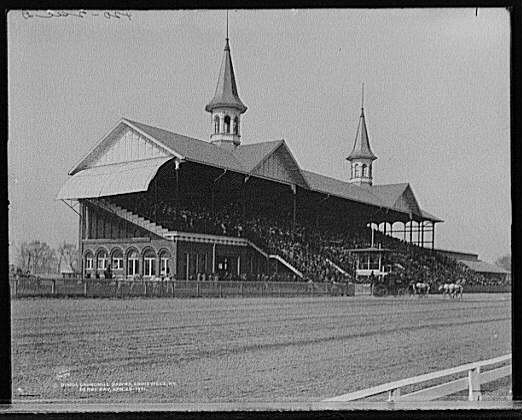
Churchill Downs 1901
Churchill Downs

The Churchill Downs and the Kentucky Derby owe their creation to Col. Meriwether Lewis Clark (grandson of William Clark of "Lewis & Clark fame").

After returning from a trip to Europe where he met with the leaders of jockey clubs in England and France, he began the development of the track to showcase the Kentucky breeding industry.

The track formally opened on May 17th, 1875 with four races scheduled.

Clark designed his three major stakes races, the Kentucky Derby, Kentucky Oaks and Clark Handicap, after the three premier races in England, the Epsom Derby, Epsom Oaks, and St. Leger Stakes respectively.

The track was first referred to as "Churchill Downs" in 1883 in an newspaper article reporting on the derby. It  would not be incorporated as "Churchill Downs" until 1937. 

Although the track's races had been popular from the start, Clark was unable to make the track profitable and in 1894 the track was taken over by "The New Louisville Jockey Club" with Clark held on as a judge at the track.


The track continued to suffer financially. In Oct, 1902 the track's operation was taken over by a group headed by former Louisville mayor Charles Grainger, Charlie Price and Matt J. Winn. and under their leadership the track showed its first profit in 1903.

This success led to the eventual consolidating of the areas racetracks and the formation of the powerful "Kentucky Jockey Club" in 1919 which served as a holding company and also oversaw the running of two other major Kentucky tracks, Latonia and Lexington. 

The association, dissolved and re-organized in 1928 as the "American Turf Organization" as they took over Fairmont Park, Lincoln Fields and Washington Park in Illinois. At this point the organization began to sell off and close tracks. By 1947 Churchill Downs was once again on its own, still affiliated with the American Turf Association but not affiliated with any of the other racetracks.

The original steeples at Churchill Downs remain, but are dwarfed by the numerous additions over the years.


MINT JULEP CUPS

Early Cups

Traditionally, mint juleps are served in silver or pewter cups. Early cups were made with coin silver. They should be held only by the bottom and top edges of the cup, allowing frost to form on the outside. Accordingly, juleps should be served with a napkin or small linen doily.

English Beaker from early 1600's

The cups themselves are descendants of silver "beakers" that were approx. the same size as today's julep cups and were often found as part of a wealthy family's silver collection. They were commonly engraved with decorative motifs, family crests or initials, and were often presented special gifts at weddings or celebrations.

German beaker from late 1600's
According to advertising going back as far as the mid-twentieth century...today's beaded design is copied from a "1795 design by a Kentucky silversmith".

It is possible that it was created that early, but I think it most likely that it would have been created as a beaker design, as the wealthy that could afford such pieces were not commonly drinking "juleps" in 1795. 

From the Rotarian, May 1964
Another theory, still possible, though less plausible, is that the original julep cup was designed as a prize for the winner of early Kentucky horse races.

Samual Ayres, who hung out his shingle in the mid-1780's, was the first well-known silversmith to work in Lexington.

Asa Blanchard was also a dominant silversmith in the area, but he worked from 1808-1838.

So while he was known for making julep cups among other things, if it was actually a known Kentucky silversmith that originated this design, and providing that 1795 was the correct date, it would more have likely been Mr. Ayres that came up with the "original design" for the julep cup.

Typical Kentucky Julep cup from the 1820's-30's
The majority of early julep cups seem to be dated to "circa 1850" with a few being dated to the 1820's. The practice of engraving dates on the cups did not become common until after the civil war.

Pre-Civil War cups are rare. Cups made earlier than the 1850's that I have been able to locate were either plain beakers or were adorned with straight lines at the top and bottom, not the beaded design attributed to the "1795 original".

Typical Kentucky Julep cup from mid 1800's

Mint Julep Cups and the Kentucky Derby

By the late nineteenth century, the Mint Julep was at the height of it's worldwide popularity. With horse racing being a fair weather activity, it is a safe bet that mint juleps have been traditionally enjoyed at racetracks since the early 1800's. 


The mint julep's link to the Kentucky Derby likely began as a matter of timing and convenience. Mint grew abundantly in the area, and bourbon - well, this was Kentucky - bourbon was of course readily available. So when the racetrack opened in 1875 mint juleps, being the popular drink of the day, were already being offered in the racetrack's clubhouse. 

As a wealthy Southerner, you would no doubt own a customized silver beaker. You would have called it a julep cup by then, though this was basically the same cup that had been used to celebrate momentous occasions for generations prior under a different name.

What started with the wealthy showing up with their own heirloom drinking vessel, which were especially well suited to that new "American Iced Drink", the Julep, gradually morphed into a new tradition. 

The beakers would have previously been used during celebrations to hold wine or punch. Over the nineteenth century however, the reason to own these heirloom beakers increasingly became for the purpose of making juleps, and of course to show off at the Kentucky Derby as a status piece.


In 1938 the Mint Julep became the official drink of the Kentucky Derby, and commemorative cups have been made available every year since.

Today the Kentucky Derby and the Mint Julep have become inseparable.

Thousands of mint juleps are still served every year at the Derby, held each year on the first Saturday in May, and at Derby parties around the nation.

Woodford Reserve and Early Times are sister brands produced by Brown-Forman, and under the terms of its current marketing agreement with Churchill Downs, Woodford Reserve is called the "official bourbon" of the derby. (Early Times, though the official julep whiskey, is a blend and cannot technically be called a bourbon).

Since 2006, Churchill Downs has also offered ultra-premium, custom-made mint juleps at a cost of $1000 each at the Kentucky Derby. 


These mint juleps have been served in gold-plated cups with silver straws, and were made from Woodford Reserve bourbon, mint imported from Ireland, ice from the Bavarian Alps, and sugar from Australia. The proceeds were used to support charitable causes dedicated to retired race horses.

For the 2011 Derby, Woodford Reserve partnered with Tiffany & Co. to create the most extravagant cups yet.
 One of  three 2011 Tiffany & Co. "Prestige Cups" in 24 karat gold, bidding started at $2,000 for these.

The 2011 Derby silver julep cup by Tiffany & Co, 100 were made to be sold at $1000 each.


TRADITIONAL LORE


Just about every Southern state had its own way of handling the mint, the sugar, the ice, the booze. The arguments over the one true "right way" to build a julep has been intense. Names have been called, and duels have been fought.

According to some, a mint julep is the not so much the product of a specific formula, but more that of the ritual and ceremony. Nevertheless, the ingredients have been contested with extreme vigor.

A true southern gentleman before the Civil War would have died before he'd drink vulgar corn whiskey. Brandy was the preferred choice. Holland gin had it's share of popularity in a julep. Even after the war, when standards had slipped, no Marylander would build his julep with anything but rye whiskey. Today, good quality straight Kentucky bourbon is the preferred choice by most.

Even the choice of mint has caused no end of debate, though spearmint is nearly universally preferred over any sort of peppermint. The general consensus is that the best mint for juleps is "Kentucky Colonel" (Mentha spicata).

Though there are countless family recipes as closely guarded as heirlooms as the cups themselves, and doubtless they all have their own merits, I will be presenting early recipes as appear in early cocktail books, rather than trying to sort out the distinct regional differences that have evolved over the years. I have no desire to insert myself into that long raging debate!

HISTORICAL RECIPES

Let's start in 1862 with the good professor Jerry Thomas's first edition of his Bar-tender's Guide.

1862 - Jerry Thomas's Bar,Tender's Guide
OK, so we have cognac, which would have been preferred in the day over most available whiskey's. Jerry wants all kinds of fruit though, Jamaica rum and powdered sugar. For a drink "fit for an emperor".

Next up, in "The gentleman's table guide" by E. Ricket and C. Thomas from 1871. Many of these recipes were lifted directly from the pages of Jerry Thomas's book. 

1871 - E. Ricket & C. Thomas' Gentleman's table guide
1884 - we check in with O. H. Byron out of New York. 

1884 - O.H. Byron The Modern Bartender's Guide
Not a whole lot of variance on the theme laid down by Jerry up to this point.

In 1892 we see even more additions this recipe by William (The Only William) Schmidt.

1892 - William Schmidt The Flowing Bowl
Ice cream and yes, you can "put a little rosebud on your drink". Try ordering one of these at Churchill Downs on Derby Day!

We have two entries in 1895, the first from George Kappeler.

1895- George Kappeler Modern American Drinks
George says 1/2 brandy and 1/2 rum...still going with all the fruit.

1895 - C.F. Lawlor The Mixicologist

The second entry from 1895 is from C.F. Lawlor. Nice notes on the building of the drink.

1902 - Here's one from Charlie Paul:

1902 - Charlie Paul American and Other Iced Drinks
Charlie says it is fit for a king. He also says to use a combination of brandy, rum and yellow chartreuse and tops it off with a dash of claret. Fancy!

In 1908 from The World's Drinks and How to Mix Them, compiled by the Hon. Wm. (Cocktail) Boothby. (Premier Mixologist no less) we have this enlightening entry:

Mint Julep.

A LA JOHNNY BRACE, NEW YORK CITY.
THE NEW STYLE

   Fill a large goblet with fine ice and pour a jigger of cognac over it; then take several sprigs of young, tender mint and place them in a medium sized mixing-glass with a dessertspoonful of bar sugar and just enough seltzer to nearly fill the goblet, in which you have already placed the fine ice and brandy. Press the mint with a muddler until the sugar is all dissolved and the water is well flavored with the mint, strain into the goblet of ice and brandy, dash with Jamaica rum, ornament with fruits and a few sprigs of mint which have been moistened and dipped in sugar, and serve with straws.

   Great Care should be used in selecting the very young tender shoots of the mint as the old shoots and leaves have a rank bitter taste and are therefore worthless for making a delicately flavored julep.

__________________________________________________

1916- Let us see what Hugo Ensslin says about the mint julep in the last book published by a New York City bartender before prohibition.

1916 - Hugo R. Ensslin Recipes for Mixed Drinks
Here we have our first truly modern mint julep recipe. Rye or Bourbon is called for. The fruit is gone, and the Jamaica Rum is now optional.

1917 - Thomas Bullock working out of the St. Louis Country Club, the last book published before prohibition and the first by an African-American author. 

1917 - Thomas Bullock The Ideal Bartender
In 1922, out of London we get this entry from Robert Vermeire:

1922 - Robert Vermeire Cocktails How to Mix Them
Nothing really new here, just a faithful recipe for the old school way of building.

Let's jump to Paris, 1927 and the famous Harry McElhone of Harry's New York Bar fame.

1927- Harry McElhone Barflies and Cocktails
We're using whiskey, but still calling for all of the fruit.


1931 and the Old Waldorf Bar Days book.

1931 - Crockett Old Waldorf Bar Days
That's a lot of water Johnnie! Still calling for the fruit. Nice simple recipe though.

1936- Paris, the Ritz...what would Frank have suggested?

1936 - Frank Meier The Artistry of Mixing Drinks
The fruit has been reduced to lemon, which does not sound bad, and he calls for bourbon.

___________________________________________________

1948 - David A. Embury The Fine Art of Mixing Drinks

Let's check in with the good Mr. Embruy before we move on. As you may imagine, he had plenty to say on the matter.

Juleps


   In the whole category of drinks there is probably none that is more delicious and certainly none that has caused more violent disagreement and acrimonious debate than the Mint Julep. Should the mint be bruised or not bruised? Should it be left in the glass or removed? Should it be blended with the whisky or should it be used merely as decoration on the top of the glass? Should the drink be served with straws or not? Should it be decorated with fruit or not? If you are interested in these or other similar details about the Julep, I suggest you write to the National Distillers Product Corporation, New York City, for their excellent little booklet on Mint Juleps. If it is not out of print (it was copyrighted in 1939), I am sure they will be glad to send you a copy.


   I have, in all, probably some thirty or forty different recipes for Juleps, some good, some bad, some indifferent. I shall give you just three-my own and two others I consider excellent. It takes two hours or more advance notice to prepare the latter. The other is for those who like only a mild mint flavor. First of all, however, there are certain cardinal principals to be observed, no matter what recipe you follow, if you want to turn out a julep that is really good and that is attractively frosted.


1. Use very tall 14- or 16-ounce containers, whether of glass or of silver. Silver mugs are best because they frost better than glass, and mugs with handles-are best because they keep the warm hand from coming in contact with the outer surface of the container, thus melting the frost. If glasses are used, the thinner the glass, the better. It is well to serve paper napkins with which to handle the glasses, thereby insulating them to some extent from the warm hand. Also serve saucers or large coasters in which to set the glasses or mugs, for some of the frost will always melt and drip.


2. Unless the drink itself if to be chilled in the refrigerator, thoroughly pre-chill the glasses by leaving them in the refrigerator as close as possible to the freezing compartment for at least a half-hour. When filling the glasses, wear wool gloves or wrap the glass in a clean dry towel to keep the warm hand from coming in contact with the glass.


3. Use only fresh mint and (except as a garnish) only the small, tender leaves at the end of each sprig. Discard all stems and all the old and large leaves.


4. Use only the best-quality bourbon-the older the better. If you want to make a Rye Julep, or a Gin Julep, or a Brandy Julep, or an Applejack Julep, well and good, but you will be on your own. I am not a Kentucky colonel-in fact, I have been in Kentucky only once-but I am firmly convinced that all other Juleps are only inferior imitations of those made with good Kentucky bourbon.


5. Use sugar syrup, not dry sugar. It not only saves time but it blends with the liquor as dry sugar and water never can.


6. For the garnish use nothing but tender, young springs of mint. Rinse them well in cold water, dry with a clean towel, and while still slightly moist, dip in powdered sugar. Clip off the end of each stem just before immersing in the drink, thus allowing the juice to bleed into the liquor.


7. Use shaved or finely crushed ice-not merely cracked ice. If you have a mechanical crusher-such as the Dazey-set it for the finest crush. If you use a canvas bag and mallet, pound until the ice is like snow. Discard all the lumps.


With these warnings and advance preparations, proceed with the actual preparation of your Juleps as below indicated. No.1 is my own favorite; No.2 the time consumer; No.3 is the one with just a faint mint flavor.


JULEP NO.1 In a bar glass place, for each drink, 1 tablespoonful of sugar syrup, about a dozen tender young mint leaves, and 2 or 3 good dashes of Angostura. If you don't like bitters, leave them out, but, in my opinion, they add enormously to the character of the drink. Bruise the mint gently with a muddler and blend the ingredients by stirring and pressing gently for several minutes. Do not crush the leaves, for this releases the bitter, inner juices. Pour about 2 ounces of bourbon for each drink into the bar glass and stir all thoroughly together.
   Remove the Julep glasses from the refrigerator, pack them with crushed ice (don't let the bare hands touch the glasses) and strain the contents of the bar glass into them. With a long bar spoon churn the contents of the glasses up and down for a few minutes. Add more ice and fill each glass to within 3/8" to 1/4" of the top with bourbon and repeat the churning process until the glass starts to frost.
   Insert long straws in the glasses, decorate with the sugared mint sprigs, and serve.
   The glasses may be returned to the refrigerator after the drinks are mixed if so desired, but this is not necessary. If they are returned, insert the straws but do not add the garnish until the moment of serving. The dry cold of the refrigerator will wilt the mint sprigs if they have been added. Also it may freeze the ice into a solid mass, making it difficult or impossible to insert the straws later.


JULEP NO.2 Prepare the mint, sugar, Angostura mixture as in No.1, but do not add the bourbon. Pour half the mixture in the bottom of the Julep glass. Half fill the glass with crushed ice, firmly packed down. Add the balance of the mint mixture and fill the glass to the top with ice. Insert straws and place the glass in the refrigerator as close as possible to the freezing compartment. Leave in there for at least an hour.
   Remove the glass from the refrigerator (insulated hands again) and gently pour into it all the bourbon it will hold up to about 1/4" from the top. Return to the refrigerator for at least another hour, then remove, add garnish, and serve.


JULEP NO.3 Pre-chill the glasses. In the bottom of each glass place a tablespoonful of sugar syrup and, if desired, stir in a few dashed of Angostura.
   Distribute three or four small sprigs (not just the leaves) of mint over the bottom of the glass but do not bruise or crush. Pack the glass full with crushed ice and fill with bourbon to within about an inch of the top. Churn with a long spoon to settle the ice and begin the frosting process. Refill with ice, add enough bourbon to bring to desired height, and insert the straws.
   Place drinks in refrigerator for at least 5 or 10 minutes (a half an hour is better, add garnish, and serve.


One of the greatly disputed points about Juleps is whether or not to float a spoonful of rum on the top of each drink. To your true Kentucky colonel, this is rank heresy. It does, however, add an exotic touch which many like. I like Juleps either with or without the rum, but if you do use rum, use only a good Jamaica rum at least 8 years old and use not more than 1 teaspoonful.
   I will also make one single concession to my role of "nothing but bonded bourbon" for a Julep. Southern Comfort, which, of course, has a bourbon base, makes an excellent Julep. The ladies, in particular, will like it better than one made with straight bourbon.
   If any of your teetotaler friends attend your Julep party I fear you will have to serve them plain ice water. I know of no prohibition variety of the Julep.


Lots to say indeed! What wonderful advice too, David Embury really knew his stuff.


I love the teetotaler friend comment. Totally extraneous, and rich with Embury's dry humor.


A few notes on his details. The Southern Comfort of his day was a much different product. It was actually good! Made with a base of real bonded bourbon, it was a 100 proof liquor made with a special blend of flavoring agents and sweeteners. Some say it was a blend of bourbon and peach brandy, but I've not found anything yet in print about that. If it was blended with peach brandy, it would have been an aged eau de vie brandy, which has become extinct at this point.


All in all, it is hard to fault any of his advice or methods. Paying close attention to the finer points of preparation and serving he has presented does pay off in the end result. 

David has provided us with a very complete and accurate entry on the mint julep. As you probably noticed, I lifted many points from his instruction to create my own recommended recipe. If you are in a hurry to make a mint julep, his "NO.1 JULEP" is absolutely the way to go.


EQUIPMENT


Did you make your julep in a glass because you did not have a julep cup? That no doubt worked, but a real, silver plated julep cup is worth picking up.

No need to shell out $600 and up for a solid silver cup. If you want, you can get good results with a nickel plated cup, as long as you do not have a silver cup sitting next to it to make it look bad that is!

Cocktail Kingdom's silver plated cup on the left, KegWorks nickel plated on the right. 

Cocktail Kingdom just got in their silver plated cups and there is no better deal on the net. At $24.95 each, they are a ridiculously good buy. They also have a nickel plated option coming soon.

Kegworks offers a good quality nickel plated brass cup for $18.75, though I hear Cocktail Kingdom's price will be lower and the quality should be slightly higher.

A few more plugs for CK's available tools. The Cocktail Kingdom muddler and their new julep strainers.

Their "Bad Ass Muddler" is just that, this thing is a beast and makes muddling anything so much easier. It has nearly weapon like heft and balance, is made of (very) heavy duty food grade plastic - and at only $12.95, it is a bargain that should last you a lifetime.

Their new julep strainers are also exceptional good and noteworthy. Using their ample library of vintage barware, every julep strainer in their collection was evaluated to find the perfect shape.

After painstakingly making sure that the mold was just right, they produced the strainer in 4 finishes, gold plated, silver plated, and in stainless steel with a matte finish and a mirrored finish. The stainless run $10.95, the silver plate is $15.95 and the gold plated runs $21.95....wow!

Wait, what about that julep strainer? Most juleps were not strained right? Do you need a julep strainer to make a julep? Well, no actually, you do not. They are great to use in any drink though and it seemed fitting to mention here, but you do not need one to make a julep.

When you make your base and muddle the mint into the simple syrup, many prefer to leave the mint in the mix so it can continue to impart flavor.

Why do they call it a julep strainer then?

In the 1820's when the iced version of the drink was first introduced, the public's dental health was not what it is today.

When a drink was served to a customer, the strainer was often left in the drink. This was to keep the ice from hitting the customer's often very sensitive teeth.

Juleps were one of the very first, if not the very first, of the iced drinks to gain worldwide popularity. So it was also a bit like calling it a "martini strainer".

The sherry cobbler, with its need to be shaken, came along around the same time or shortly after, and eventually brought along with it the popularization of the new cobbler shaker. More importantly however, the popularity of the drinking straw.

The drinking straw eliminated the need to leave the customer with the strainer, but by then the nickname had stuck and this, the original strainer design became known as the julep strainer. (The "Hawthorne" strainer design would not come about until 1889, even then, the patent application called it a julep strainer.)


ENJOY YOUR JULEP!