Providing cocktail recipes, techniques, equipment reviews, tasting notes and more. Writing about the best cocktails from yesterday and today, with an emphasis on the historical. Nothing too complicated. These are simple recipes written with the home user in mind, using the best available ingredients. Novices and pros alike should find something of interest here...
Showing posts with label Rum. Show all posts
Tuesday, August 30, 2011
The Little Buddy
It has been a fantastic summer and I've been taking time off, delving into new flavor combinations, and at times taking a break from cocktails altogether. Summer is drawing to a close meaning my vacation is just about over, must also be time to return to the blog!
Here's an off the cuff rum based riff on the "Old Pal" that turned out especially well. With a rum base, why not an island reference? Here's the "Little Buddy":
The Little Buddy
1 1/2 oz (45 ml) Anejo Rum
3/4 oz (22 ml) Lillet Blanc
1/2 oz (15 ml) Campari
1/4 oz (7 ml) Aperol
1-2 dashes Falernum Bitters
Stir well with ice, strain into a double old fashioned glass with a large ice cube, spray lemon twist over top and use as garnish.
If the "Old Pal"is a nice, light summer drink, then the "Little Buddy" could be a nice "dark" summer drink?
Either way, I have found it to be a wonderfully easy-to-drink apertif, and a welcome one to mix into my regular rotation of summer Negronis.
Wednesday, July 6, 2011
Sitting Bull Fizz
Here's an interesting fizz variation from 1892. From The Flowing Bowl, by The Only William (William Schmidt).
Sitting Bull died on December 15, 1890, around the time William would have been working on his book. This is a good drink, so I'm of a mind that this recipe was meant to be a respectful tribute.
![]() |
| From The Flowing Bowl by William Schmidt, 1892 |
Santa Cruz rum of the day was a generic term for light, golden rums that came from the Virgin Islands. Cruzan is certainly a geographically correct rum choice. For my drink I wanted something golden, with good character - so why not Havana 7?
William worked in the New York area, and since the recipe does not call for bourbon, or "Kentucky whiskey" by name, rye whiskey is a safe choice. My choice, Rittenhouse Bonded!
Sitting Bull Fizz
1 ounce (30 ml) rye whiskey
1 ounce (30 ml) lemon juice
1/2 ounce (15 ml) golden rum
1 teaspoon (5ml) simple syrup
Shake well with cracked ice, strain into a collins glass and top with soda water. Stir with spoon and serve.
This is fantastically good, especially on a hot day. A dash of angostura bitters really brings the flavors of the drink together nicely.
The Rittenhouse Bonded 100 proof base lends a nice backbone, but at only an ounce it is not overwhelming. The Havana 7 lends a wonderful exotic sweetness to help the simple syrup balance the lemon juice.
All in all, a very nice fizz! Wait, I better have one more quick just to make sure....
Thursday, June 2, 2011
Fluffy Ruffles - Updated
(Still) A nice gem from Hugo Ensslin's Recipes for Mixed Drinks (1916-1917)
I had originally thought it a fairly safe assumption that "Rin of I lime" was a mistake in the printing, and that the intent was "juice of 1 lime" - Thanks to Frederic over at Cocktail
I have revised this entry accordingly.
Fluffy Ruffles
1 1/2 ounces (45 ml) Havana Anejo Reserva
1 1/2 ounces (45 ml) Cocchi Vermouth di Torino
Rind of 1 lime (2 pre-juiced lime halves)
Shake well with cracked ice and strain into a cocktail glass.
You'll want a good aged rum with lots of character, but nothing as thick and dark as say an El Dorado 15 or as full hogo as a Smith & Cross. What you will want is a "Planter's Best"( for those of you familiar with Wondrich's rum descriptions in his book "Punch".)
In the absence of a good aged Havana Club rum, go with one of the aged Flor de Cana rums like the Grand Reserva 7 or the Centenario 12.
I'm really enjoying my new bottle of Cocchi Vermouth di Torino which is why I'm using it here. Carpano Antica should do nicely here too.
So...revised drink, revised tasting notes. Shaking this drink nice and hard to really infuse the mix with the lime, and double straining, I ended up with (not surprisingly) a very different drink. Much more of a "limey Palmetto".
Lime then rum taking front seat on the nose, followed by very subtle hints of the vermouth. The drink is light and fresh on the palate. Now the rum and vermouth play better together providing a very enjoyable "Manhattan" like experience.
The essence of lime provided by shaking with the rind gives a very nice, fresh citrus profile, and without the full sour of my earlier drink (where I used the juice of 1 lime). It is spot on actually, and now I have something to do with some of those used lime rinds! I'll be playing with this technique for sure.
Thanks again Frederic for the comments!
Friday, April 1, 2011
Nuclear Daiquiri
The Nuclear Daiquiri, as it appears in the Big Bartender's Book by Mud Puddle.
Nuclear Daiquiri
3/4 ounce (22 ml) Wray & Nephew Overproof Rum
3/4 ounce (22ml) green Chartreuse
1/3 ounce (10 ml) falernum
3/4 ounce (22 ml) lime juice
Shake with Ice and strain into a cocktail glass.
My eyes were closed, but I think I dipped dangerously close to sucking the mix in through my nose as I inhaled the aromas. The Chartreuse green really comes to life in this mix with a big, resinous forest pine aroma.
I have used John D. Taylor's "Velvet Falernum" in this drink many times in the past with good results. This was the first time I tried the recipe with the Trader Tiki's Falernum, and viva la differance!
The bottle of falernum claims flavors of "Lime, Ginger, Almond, Clove and hints of Jamaican potstill rum."
When mixed with the clear, bright, grassy-sweet "Wray and Nephew Overproof",and the 130 herbal extracts present in the Chartreuse green, it is very easy to get lost in the aroma alone.
The flavors are no less complex. The resinous pine comes through on the palate. The mix of herbals, ginger, clove and lime all getting along remarkably well.
If you are looking for a rich and full-bodied daiquiri, go Nuclear!
The drink was created by Gregor De Gruyther (1979-2009).
Thursday, March 17, 2011
Culross
If we are to attribute this drink to the town in Scotland by the same name, it would be pronounced "Coo-ros".
There's not much out there with this rather strange name, so its not a bad bet that this drink was named after the town, or possibly after a patron from Culross that the Harry Craddock era Savoy Hotel Bar honored in the naming of this one.
It does not seem very Scottish in nature, but Culross is a coastal town, and the maritime influenced Scots have been known to enjoy their fair share of rum.
At any rate, this appears first in the Savoy Cocktail book in 1930 with the following instructions:
The Culross Cocktail
The Juice of 1/4 Lemon.
1/3 Kina Lillet.
1/3 Bacardi Rum.
1/3 Apricot Brandy.
Shake well and strain into cocktail glass.
Adopted for modern use you have:
The Culross Cocktail
3/4 oz (22 ml) Havana Club Anejo Blanco rum
3/4 oz (22 ml) Apry
3/4 oz (22 ml) Cocchi Americano
3/4 oz (22 ml) Lemon Juice
Shake well and strain into a cocktail glass.
Since Havana Club is still made in much of the old Bacardi factory, in much the same way, and aged in the exact same spots as the old Cuban Bacardi, it is always your best bet when an old recipe calls out for Bacardi specifically.
If you are unable to use Havana Club, go for Flor de Caña Extra Dry 4 year, a rum that is much closer in character to the original Cuban Bacardi than the modern Barcardi Dry made in Puerto Rico.
The closest thing that we have on the market today to Kina Lillet, is Cocchi Americano (rather than Lillet Blanc.) It is bolder and more spice forward than Lillet Blanc. They are both traditional white aperitif wines, Lillet coming from France and the Cocchi from Italy, and their histories are intertwined.
For some recipes they can be used interchangeably. For other recipes, one works well where the other can be glaringly off. Since this one called for Kina Lillet by name, Cocchi Americano seemed the obvious choice.
This is an interesting mix, you have the Cocchi and lemon juice on side, providing dry and sour flavors. On the other side you have the light, sweet rum and the big flavored Apy.
If you have been able to secure a bottle of Marie Brizard Apry (it can be a challenge to locate) - this is a nice way to use it as it works very well here. It is just sweet enough to make up for the lack of sugar or simple syrup, and its apricot fruit flavor works great with the other flavors here making for a sweet, yet oddly dry mix.
If you are unable to use Havana Club, go for Flor de Caña Extra Dry 4 year, a rum that is much closer in character to the original Cuban Bacardi than the modern Barcardi Dry made in Puerto Rico.
The closest thing that we have on the market today to Kina Lillet, is Cocchi Americano (rather than Lillet Blanc.) It is bolder and more spice forward than Lillet Blanc. They are both traditional white aperitif wines, Lillet coming from France and the Cocchi from Italy, and their histories are intertwined.
For some recipes they can be used interchangeably. For other recipes, one works well where the other can be glaringly off. Since this one called for Kina Lillet by name, Cocchi Americano seemed the obvious choice.
This is an interesting mix, you have the Cocchi and lemon juice on side, providing dry and sour flavors. On the other side you have the light, sweet rum and the big flavored Apy.
If you have been able to secure a bottle of Marie Brizard Apry (it can be a challenge to locate) - this is a nice way to use it as it works very well here. It is just sweet enough to make up for the lack of sugar or simple syrup, and its apricot fruit flavor works great with the other flavors here making for a sweet, yet oddly dry mix.
Saturday, March 5, 2011
Palm Breeze
This one appears in Mud Puddle's Cocktail Handbook by Jeff Masson and Greg Boehm and was adopted from a recipe appearing in the 1953 edition of the United Kingdom Bartenders' Guild Guide To Drinks.
Palm Breeze
1 1/2 oz (45 ml) Jamaican dark rum
1 ounce (30 ml) yellow Chartreuse
1/2 ounce (15 ml) white creme de cacao
1/2 ounce (15 ml) lime juice
1 dash grenadine
Shake with ice and strain into a cocktail glass.
Wow this one's good! Big rum, the chocolate is subtle and the yellow Chartreuse brings it all together. With only 1/2 ounce of lime juice this is a more booze forward sour.
I used Smith & Cross for the Jamaican rum and subbed in Mozart Dry for the white creme de cacao.
The dash of grenadine providing a little color and just a touch of sweet to back those boozy flavors off a bit.
The results are a deep dark & earthy "daiquiri-style" drink. A challenging drink, but very much "yum" in my book.
Tuesday, February 1, 2011
K.O. Cocktail
Here again, a wonderful treasure from the Cafe Royal Cocktail Book (1937).
THE K.O.
1 1/2 ounces (45 ml) London dry gin
3/4 ounce (22 ml) Jamaica Rum
3/4 ounce (22 ml) French Vermouth
Stir well with ice in a mixing glass and strain into a cocktail glass.
I went with Lillet blanc here, as I thought it would go better with the Smith & Cross rum than a traditional French Vermouth, but Noilly Prat should be good here too.
The gin, even though it makes up half the drink, takes a back seat to the Smith & Cross, which really comes to life in this cocktail. The silky texture and light florals of the Lillet also work extremely well.
I actually was a bit knocked out by this one. I like my Martini's wet, and love gin and Lillet together. The addition of a "full-hogo" high-proof rum, not as a base but as a balancing flavor, is brilliant.
It leaves me with one thing to say. "The drink is nice, Heini."
Friday, January 28, 2011
Rum Hound
I found this one in the "Big Bartender's Bible" from Mud Puddle books. It was created by Jim Schwenck and published in 1930 in the rather oddly named release, The Home Bartender's Guide & Song Book.
The rum hound is a nice rum "sidecar" variation. I thought that there might be too much Cointreau in this recipe, but it was just right. This is a recipe that someone obviously took some time in balancing out.
Some drinks are good because you can still get sense of all the individual players and no one flavor is stomping over another - a perfect balance.
Other drinks are great because the whole becomes greater than the sum of the parts, something new and wondrous born from the perfect blending of ingredients.
The rum hound seems to fit into the latter category. The Smith & Cross is fantastic here and would be hard to beat as a match for the Cointreau...and who knew there was this kind of orange flavor to be brought out from Cointreau?
Rum Hound
1 1/2 ounces (45 ml) Jamaica dark rum
1 1/2 ounces (45 ml) Cointreau
3/4 ounce (22 ml) lemon juice
Shake with ice and strain into a cocktail glass.
The rum hound is a nice rum "sidecar" variation. I thought that there might be too much Cointreau in this recipe, but it was just right. This is a recipe that someone obviously took some time in balancing out.
Some drinks are good because you can still get sense of all the individual players and no one flavor is stomping over another - a perfect balance.
Other drinks are great because the whole becomes greater than the sum of the parts, something new and wondrous born from the perfect blending of ingredients.
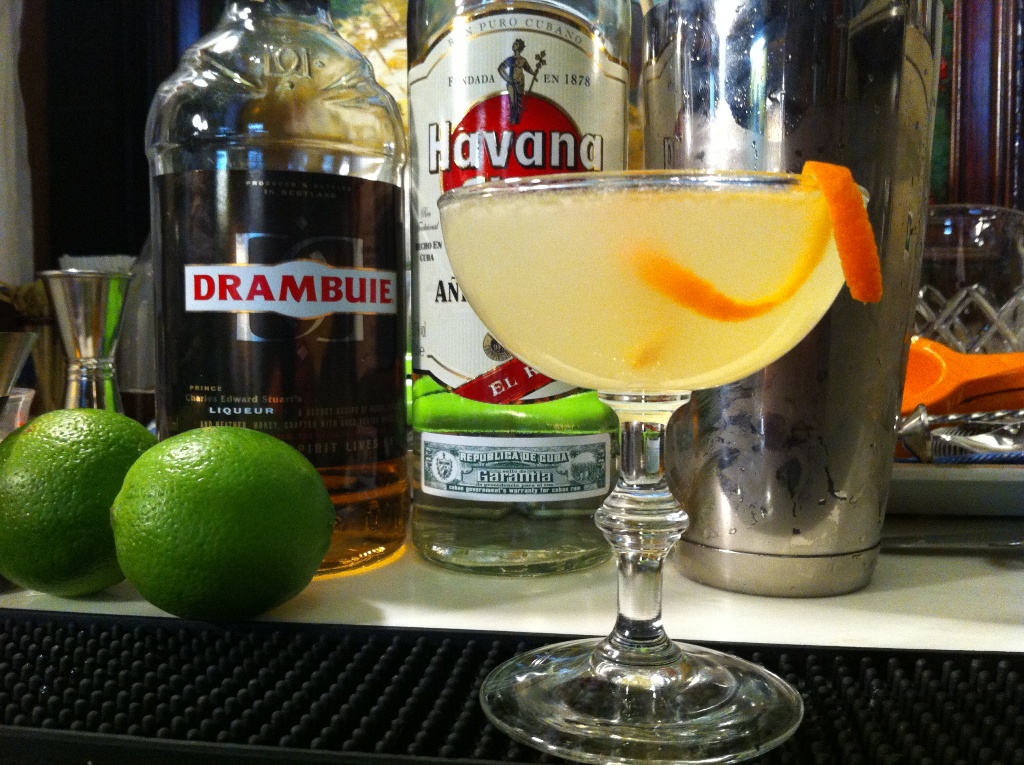
The rum hound seems to fit into the latter category. The Smith & Cross is fantastic here and would be hard to beat as a match for the Cointreau...and who knew there was this kind of orange flavor to be brought out from Cointreau?
![]() |
| The Home Bartender's Guide and Song Book (1930) By Charlie Roe & Jim Schwenck |
Wednesday, January 26, 2011
Deansgate Cocktail
A fairly anonymous creation which is known mainly as a traditional Scottish drink, the Deansgate is most likely named after the area of Deansgate in Manchester, England, which was once a very important trading center in the region.
[Update, January 31st, 2011: While it is absent from the 1934 edition of "Approved Drinks authorized by the United Kingdom Bartender's Guild", the "Deansgate" shows up in the 1937 edition that was published as the "Cafe Royal Cocktail Book", and the recipe calls for "Rose's Lime Juice".
Here, it is attributed to one "J.E. (Ted) Player". What's not clear, is if the recipe was created by "Ted", or if the Rose's lime was his twist on an older, traditional recipe.
Here's how the 1937 recipe appeared:
Anyone have any further info on this one supporting it's existence prior to 1937? Would love to hear!]
The Deansgate is basically a "Drambuie sour", with the Drambuie's honey providing all the sweet and it's herbs providing the extra "je ne sais quoi". Seriously...if you put this drink in front of me and asked me to name the ingredients I would be hard pressed to find the Drambuie.
It's as if Drambuie was a concentrate, and the rum and lime juice dilute it to the point of perfect balance, making the normally thick and even unctuous Drambuie, into an ethereal pleasure. The honey is sweet but not cloying, the scotch very mild if describable at all, and the herbs bring a light, floral playfulness into the normally crisp,dry...even sterile world of the light daiquiri.
The traditional recipe goes "One measure of Drambuie, one measure of lime juice and two measures of white rum."
So in other words...
The Deansgate
1.5 ounces (45 ml) light rum (like Havana blanco or El Dorado 3)
3/4 ounce (22 ml) Drambuie
3/4 ounce (22 ml) lime juice
Shake with ice and strain into a cocktail glass. Garnish with an orange twist.
Saturday, January 22, 2011
Fannie Ward Cocktail
Here's a third drink from "The Ideal Bartender" (1917) written by Thomas Bullock. Before I get into the drink though, a bit about it's author.
The Ideal Bartender is the first cocktail book to be written by an African-American. (An original copy recently sold on ebay for more than $2500, but you can find it on Google books for free).
He worked for over 25 years at the very exclusive "St. Louis Country Club", and made drinks for the social elite and their visiting guests.
Thomas Bullock (1873-1964) author of "The Ideal Bartender" |
By way of introduction to the man and his book, the following appears on page 3:
Colonel Roosevelt's fatal admission that he drank just a part of one julep at the St. Louis Country Club will come vегу near losing his case.
Who was ever known to drink just a part of one of Tom's? Tom, than whom there is no greater mixologist of any race, color or condition of servitude, was taught the art of the julep by no less than Marse Lilburn G. McNair, the father of the julep. In fact, the very cup that Col. Roosevelt drank it from belonged to Governor McNair, the first Governor of Missouri, the great-grandfather of Marse Lilburn and the greatgreat-grandfather of the julep.
As is well known, the Country Club mint originally sprang on the slopes of Parnassus and was transplanted thence to the bosky banks of Culpeper Creek, Gaines County, Ky., and thence to our own environs; while the classic distillation with which Tom mingles it to produce his chief d'oeuvre is the oft-quoted liquefied soul of a Southern moonbeam falling aslant the dewy elopes of the Cumberland Mountains.
To believe that a red-blooded man, and a true Colonel at that, ever stopped with just a part of one of those refreshments which have made St. Louis hospitality proverbial and become one of our most distinctive genre institutions, is to strain credulity too far. Are the Colonel's powers of self restraint altogether transcendent? Have we found the living superman at last?
When the Colonel says that he consumed just a part of one he doubtless meant that he did not swallow the mint itself, munch the ice and devour the very cup."
By the way, the "Colonel" was Theodore Roosevelt, who was more commonly addressed as "Colonel Roosevelt" in the years after he left the White House in 1909 until his death in 1919.
Fannie Ward, for whom the drink in this post was named, was an early star of the stage and silver screen. She was known for her comedic roles and in 1915 appeared in Cecil B. Demille's sex-charged film, The Cheat.
The drink named in her honor appears in Tom's book as follows:
FANNIE WARD
Use a large Mixing glass with Lump Ice.
White of an Egg.
Juice 1/2 Lime.
2 dashes imported Grenadine.
1 jigger Bacardi Rum.
Shake and strain into Cocktail glass.
My adaptation...
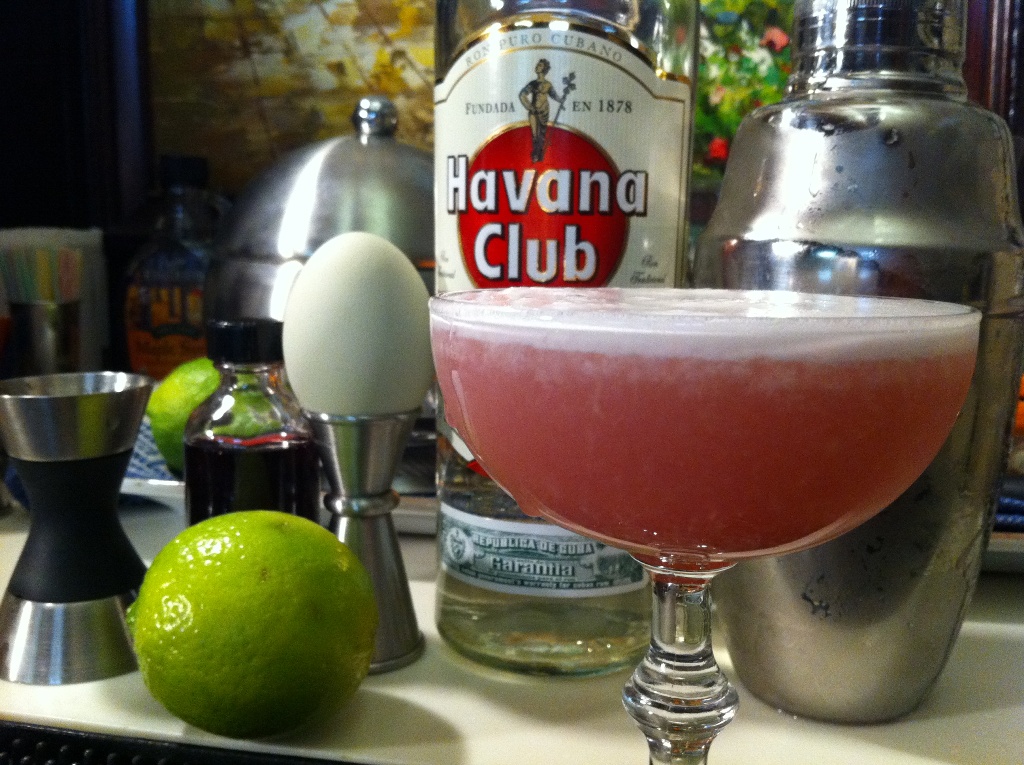
FANNIE WARD
2 ounces (60 ml) white rum.
3/4 ounce (22 ml) lime juice.
1/4 ounce (7.5 ml) Grenadine.
White of an Egg.
Shake ingredients once with ice, once without, and strain into Cocktail glass.
1/4 ounce (7.5 ml) Grenadine.
White of an Egg.
Shake ingredients once with ice, once without, and strain into Cocktail glass.
Friday, January 14, 2011
The Flip
| Mixology Monday January 17, 2011 |
This is my first MxMo so pardon the lengthy post, if you poke around my site you'll find several more long posts on drinks and their histories.
My original recipe, the "Mountain Flip", which is made with Stranahan's, Averna and Chartreuse yellow, is at the very bottom if you want to skip ahead.
Earlier this month I wrote about eggnog or "Egg Nogg" as it was sometimes written. Like eggnog, the "Flip" is more of a class of drinks, with many variations rather than being a singular recipe. The term "Flip" was first used in 1695, to describe a mixture of beer, rum and sugar, which was heated with a red-hot iron.
Both drinks are defined as being made from spirits, eggs, sugar and spice - the only difference being that eggnog adds milk or cream.
When researching the flip I came across an earlier version of the chart presented by "Dr. Rush" in 1813, which I had used in the eggnog post to illustrate it's status as a drink of ill repute.
The chart below was first published by Dr. John Coakley Lettsom in 1789, for the benefit of the "Philanthropic Society", and was seemingly the inspiration for Dr. Rush's chart.
I then found in "Gentleman's Magazine", reference that Lettsom's list here was "derived from (hints from) his friend, Dr. Rush"....so the men appear to have been acquainted and may have worked on this together.
Here's the earlier list published by Lettsom.
FLIP RECIPES THROUGH TIME
1792 - An earlier American recipe for the Flip, from a book titled "The American Geography" by Jedidiah Morse. While describing the amount of rum produced in New England the previous year, the Flip recipe was added as a footnote.
No less than 4783 hogsheads of New England rum were distilled and exported from this state last year, besides the home consumption, which was not inconsiderable *
* New England rum is distilled from molasses imported from the West Indies. It may be a question worthy of consideration, whether the molasses, which is annually distilled in New England, by being mixed with water, would not afford a drink cheaper, more palatable, and more nourishing, than that which is made from the rum distilled from it, and treble in quantity? If so, all the labour and expense of distillation might be spared, and converted to more useful, and perhaps to more lucrative manufacture or agricultural purposes. New England rum is by no means a wholesome liquor. Dr. Douglass has asserted, "That it has killed more Indians than their wars and sickness. It does not spare white people, especially when made into flip, which is rum mixed with small beer and Muscovado sugar."
Further historical recipes included (among may others, this is by no means a complete list):
1801 - "American herbal; or, Materia medica" by Samuel Stearns:
This kind of liquor is made by putting a spoonful of brown sugar into about five or six jills (sic/gills) of malt beer, which is then warmed by putting a hot iron into it, called a logger-head ; afterwards, half a pint of rum or brandy is added, and the mixture well stirred with a spoon. Then a little nutmeg is grated on the top, which makes the flip fit for (y)ule.
This quantity is enough for four men....Flip is also made with spruce beer, instead of malt, and then it is called callabogus.
1810 - "Critical pronouncing dictionary" by John Walker, the Flip is defined simply as a "drink made of beer and rum".
1822 - "The Cook's Oracle" by William Kitchiner, we are given this recipe for the flip, which would be reprinted, nearly word-for-word, in several publications over the next 20-30 years:
"Keep grated Ginger and Nutmeg with a little fine dried Lemon Peel rubbed together in a mortar. To make a quart of Flip: - Put the Ale on the fire to warm, - and beat up three or four Eggs with four ounces of moist Sugar, a teaspoonful of grated Nutmeg or Ginger, and a quartern of good old Rum, or Brandy. When the Ale is near to boil, put it into one pitcher, and the Rum and Eggs, &c. into another ; turn it from one pitcher to another till it is as smooth as Cream.
This recipe remains the standard until the 1850's when new variations start to appear in print.
In 1855, Peterson's magazine published this recipe:
Egg Flip.—Beat up in a three-pint jug four newlaid eggs, omitting two of the whites; add six large lumps of sugar and rub these well into eggs; pour in boiling water about half a pint at a time; and when the jug is nearly full, add two tumblers of brandy and one of rum.
1858 - Lewis Feuchtwanger in his book "Fermented Liquors" gives another hot Flip recipe:
Flip.—To 1/3 of a gallon of white beer (Berlin), add 1/4 of a pound of sugar, 1 drachm of fine cinnamon, a few cloves, a little ginger, 1 pint of Jamaica rum, and 4 eggs, the yellow of which is muddled. The beer, spices, yellow of the eggs, and rum are heated and well stirred together; they are then added to the first and drank hot.
1862 - Jerry Thomas's original 1862 collection of flip recipes, though extensive, did not include any "cold flip" recipes. Organized by Jerry into a chapter entitled "Flip, Negus and Shrub" he included recipes for "Rum Flip" (2 versions), Ale Flip, Egg Flip (2 versions), and a Brandy Flip.
In the 1882 reprint there appeared the addition of Cold flip recipes for Brandy, Rum, Gin, Whiskey and Port Wine.
I've included his hot and cold recipes for the "Rum Flip":
Cold Rum Flip. (From 1882 re-release)
(Use large bar-glass.)
Take 1 teaspoonful of powdered sugar, dissolved in
a little water.
1 wine-glass of Jamaica rum.
1 fresh egg.
2 or 3 lumps of ice.
Shake up thoroughly, strain in a medium glass, and
grate a little nutmeg on top.
1882 also saw the first release of Harry Johnson's "New and Improved (Illustrated) Bartender's Manual" which included a Brandy Flip, Claret Flip, Port Wine Flip and Sherry Flip. I guess he had a thing for wine-based flips. His Brandy Flip was described thus:
Brandy Flip
(Use a large bar glass.)
1 fresh egg;
3/4 tablespoonful of sugar;
3/4 glass of shaved ice
1 wine glass full of brandy(Martell);
Shake the above ingredients well in a shaker, strain into a flip or other fancy bar glass, and grate a little nutmeg on top, and serve.
1884 - "Modern Bartender's Guide" by B.O. Byron lists all chilled flip recipes including the Brandy, Gin, Glasgow, Port Wine, Sherry and Whiskey flips.
Ale Flip.
Beat up one egg with half a tablespoonful fine sugar, then fill the glass with ale; mix well with the egg and sugar. Grate nutmeg on top and serve.
Brandy Flip.
A mixing-glass half-full fine ice, one tablespoonful fine sugar, one fresh egg, one jigger brandy; shake well, strain into thin glass. Grate nutmeg on top.
Egg Flip.
One fresh egg, one tablespoonful fine sugar, one jigger sherry in a mixing-glass half-full fine ice; shake well, strain into thin glass, grate nutmeg on top.
Gin Flip.
Prepare in the same manner as Egg Flip, substituting Tom gin for sherry.
Glasgow Flip.
Beat up a fresh egg with one tablespoonful fine sugar and the juice of one lemon. Put this preparation in a long thin glass, add a lump of ice, fill up with a cold bottle of imported ginger ale; mix well. Serve.
Golden Flip.
One pony maraschino, one pony yellow chartreuse, half a tablespoonful fine sugar, one egg; shake well in a mixing-glass half-full fine ice, strain into a fancy bar-glass, grate a little nutmeg on top.
Jamaica Rum Flip.
Fill a mixing-glass half-full fine ice, add half a tablespoonful fine sugar, one egg, one jigger Jamaica rum; shake well, strain into a fancy barglass. Serve with a little grated nutmeg on top.
Port Wine Flip.
Prepare in the same manner as Jamaica Rum Flip, substituting port wine for rum.
Rum Flip.
Prepare same as Sherry Flip, using the kind of rum desired by the customer in place of sherry.
Sherry Flip.
Break a fresh egg into a mixing-glass; add one tablespoonful fine sugar, fill the glass half-full of fine ice, add one and a half jigger of sherry; shake well, strain into a fancy bar-glass. Serve with a little grated nutmeg on top.
Whiskey Flip.
Prepare in the same manner as Sherry Flip, substituting whiskey for sherry.
Yankee Flip.
Prepare in the same manner as Sherry Flip, using one jigger apple brandy in place of sherry.
(I must say, a very tasty sounding list..)
1889 - Charles Henry Cook in "Curiosities of ale and beer", describes a hot flip recipe, which by then had become something of a relic.
Flip, once a popular drink, and not altogether without its patrons in the present day, is made in a variety of ways. The following receipt is a good one. Place in a saucepan one quart of strong ale together with lumps of sugar which have been well rubbed over the rind of a lemon, and a small piece of cinnamon. Take the mixture off the fire when boiling and add one glass of cold ale. Have ready in a jug the yolks of six or eight eggs well beaten up with powdered sugar and grated nutmeg. Pour the hot ale from the saucepan on to the eggs, stirring them while so doing. Have another jug at hand and pour the mixture as swiftly as possible from one vessel to the other until a white froth appears, when the flip is ready. One or two wine glasses of gin or rum are often added. This beverage made without spirits is sometimes called Egg-hot, and Sailor's Flipcontains no ale. A quart of Flip is styled in the Cook's Oracle a "Yard of Flannel."
(Side note: The term "Yard of Flannel" has been attributed to the appearance of the liquid when "tossed back and forth from one pitcher to another at arm's length.")
1891 - in William Schmidt's "The Flowing Bowl", the flip is given as a hot recipe, "punch style" of course:
One and a half quarts of beer are heated to boiling, with a stick of cinnamon, a small piece of ginger, two or three cloves, and some lemon-peel; meanwhile mix the yolks of four eggs with a large wineglassful of rum or arrack, two or three tablespoonfuls of pulverized sugar, and a small spoonful of corn-starch; add this, while continually stirring, to the beer; pour it a few times from one vessel into another, strain through a sieve, and serve in cups.
So we reach the twentieth century and find that the flip has become an old drink, on it's way out of style, but still "not altogether without its patrons". No longer popularly prescribed to ward off a cold or other sickness, it was now more commonly served cold, and taken whenever the mood struck.
The flip then, was really a drink for the eighteenth and nineteenth centuries. By the 1900's it had transformed from a way to ward off the winter cold into a full fledged cocktail, and then by the mid-to-late twentieth century, it had fallen back into obscurity.
1917 - In the last book written by a working bartender in NYC, Hugo R. Ensslin gives some of the best (and strangest..whiskey-peppermint?) advice on the building of a cold flip:
1936 - Frank Meier, of the "Ritz" bar in Paris included this page on Flips in his book "The Artistry of Mixing Drinks".
1948 - David A. Embury, in "The Fine Art of Mixing Drinks" gives these words on the flip:
FLIPS A Flip is any wine or liquor shaken up with sugar and a whole egg. The usual proportions are 1 teaspoonful sugar or sugar syrup, 1 whole egg, and 2 ounces liquor to each drink. Shake with cracked or finely crushed ice and strain into a small Sour or Delmonico glass (about 3 to 4 ounces). Decorate with a dash of nutmeg.
Which sums up the cold flip nicely.
After all of this, I had to play around with the recipes. For this one though, I stuck with the cold flips. I've heard that Cocktail Kingdom will be producing Blue Blazer mugs before too long...so when those are in I'll play with hot flip recipes. Until then, here are a few cold flip variations that I enjoyed.
Rum Flip
1 ounce (30 ml) Angostura 1919 Rum
1 ounce (30 ml) Smith & Cross Rum
1 fresh laid egg
1 teaspoon powdered sugar
1/4 (1.25 ml) teaspoon water
2 dashes Angostura bitters
(Alternatively you can shake ingredients without ice, then with - this is the old "pre-double shake" style of building an egg drink)
1) Combine bitters, water and powdered sugar at bottom of a shaker and stir until sugar has dissolved.
2) Add one whole (fresh as possible) egg and muddle or stir the yolk to break it up.
3) Fill tumbler 3/4 full with finely cracked or crushed ice.
4) Add the two ounces of rum.
5) Shake hard for 60-90 seconds, strain into a cocktail glass and garnish with fresh ground nutmeg.
The classic rum flip. The lack of milk or cream provides more room for the spice flavors from the nutmeg and bitters to come through. When combined with the egg's thick silky texture, and the deep flavors of the dark rums, I must say I'm "flipping" out over how good this is. It really is a well balanced drink, providing room for all the flavors to stand both together and alone, which is the hallmark of a great drink recipe.
Using the same method of construction, here are a few more variations:
Egg Flip.—Beat up in a three-pint jug four newlaid eggs, omitting two of the whites; add six large lumps of sugar and rub these well into eggs; pour in boiling water about half a pint at a time; and when the jug is nearly full, add two tumblers of brandy and one of rum.
1858 - Lewis Feuchtwanger in his book "Fermented Liquors" gives another hot Flip recipe:
Flip.—To 1/3 of a gallon of white beer (Berlin), add 1/4 of a pound of sugar, 1 drachm of fine cinnamon, a few cloves, a little ginger, 1 pint of Jamaica rum, and 4 eggs, the yellow of which is muddled. The beer, spices, yellow of the eggs, and rum are heated and well stirred together; they are then added to the first and drank hot.
1862 - Jerry Thomas's original 1862 collection of flip recipes, though extensive, did not include any "cold flip" recipes. Organized by Jerry into a chapter entitled "Flip, Negus and Shrub" he included recipes for "Rum Flip" (2 versions), Ale Flip, Egg Flip (2 versions), and a Brandy Flip.
In the 1882 reprint there appeared the addition of Cold flip recipes for Brandy, Rum, Gin, Whiskey and Port Wine.
I've included his hot and cold recipes for the "Rum Flip":
145.
—Which Dibdin has immortalized as the favorite beverage of sailors (although we believe they seldom indulge in it) —is made by adding a gill of rum to the beer, or substituting rum and water, when malt liquor cannot be procured. The essential in "flips" of all sorts is, to produce the smoothness by repeated pouring back and for ward between two vessels, and beating up the eggs well in the first instance; the sweetening and spices according to taste.
146. Rum Flip.
(Another method.)
Keep grated ginger and nutmeg with a little fine dried lemon peel, rubbed together in a mortar.
To make a quart of flip:—Put the ale on the fire to warm, and beat up three or four eggs with four ounces of moist sugar, a teaspoonful of grated nutmeg or ginger, and a gill of good old rum or brandy. When the ale is near to boil, put it into one pitcher, and the rum and eggs, &c., into another; turn it from one pitcher to another till it is as smooth as cream.
Cold Rum Flip. (From 1882 re-release)
(Use large bar-glass.)
Take 1 teaspoonful of powdered sugar, dissolved in
a little water.
1 wine-glass of Jamaica rum.
1 fresh egg.
2 or 3 lumps of ice.
Shake up thoroughly, strain in a medium glass, and
grate a little nutmeg on top.
1882 also saw the first release of Harry Johnson's "New and Improved (Illustrated) Bartender's Manual" which included a Brandy Flip, Claret Flip, Port Wine Flip and Sherry Flip. I guess he had a thing for wine-based flips. His Brandy Flip was described thus:
Brandy Flip
(Use a large bar glass.)
1 fresh egg;
3/4 tablespoonful of sugar;
3/4 glass of shaved ice
1 wine glass full of brandy(Martell);
Shake the above ingredients well in a shaker, strain into a flip or other fancy bar glass, and grate a little nutmeg on top, and serve.
1884 - "Modern Bartender's Guide" by B.O. Byron lists all chilled flip recipes including the Brandy, Gin, Glasgow, Port Wine, Sherry and Whiskey flips.
1895 - George Kappeler's "Modern American Drinks" does away with the hot flip altogether and lists a dozen flip recipes, all iced:
Ale Flip.
Beat up one egg with half a tablespoonful fine sugar, then fill the glass with ale; mix well with the egg and sugar. Grate nutmeg on top and serve.
Brandy Flip.
A mixing-glass half-full fine ice, one tablespoonful fine sugar, one fresh egg, one jigger brandy; shake well, strain into thin glass. Grate nutmeg on top.
Egg Flip.
One fresh egg, one tablespoonful fine sugar, one jigger sherry in a mixing-glass half-full fine ice; shake well, strain into thin glass, grate nutmeg on top.
Gin Flip.
Prepare in the same manner as Egg Flip, substituting Tom gin for sherry.
Glasgow Flip.
Beat up a fresh egg with one tablespoonful fine sugar and the juice of one lemon. Put this preparation in a long thin glass, add a lump of ice, fill up with a cold bottle of imported ginger ale; mix well. Serve.
Golden Flip.
One pony maraschino, one pony yellow chartreuse, half a tablespoonful fine sugar, one egg; shake well in a mixing-glass half-full fine ice, strain into a fancy bar-glass, grate a little nutmeg on top.
Jamaica Rum Flip.
Fill a mixing-glass half-full fine ice, add half a tablespoonful fine sugar, one egg, one jigger Jamaica rum; shake well, strain into a fancy barglass. Serve with a little grated nutmeg on top.
Port Wine Flip.
Prepare in the same manner as Jamaica Rum Flip, substituting port wine for rum.
Rum Flip.
Prepare same as Sherry Flip, using the kind of rum desired by the customer in place of sherry.
Sherry Flip.
Break a fresh egg into a mixing-glass; add one tablespoonful fine sugar, fill the glass half-full of fine ice, add one and a half jigger of sherry; shake well, strain into a fancy bar-glass. Serve with a little grated nutmeg on top.
Whiskey Flip.
Prepare in the same manner as Sherry Flip, substituting whiskey for sherry.
Yankee Flip.
Prepare in the same manner as Sherry Flip, using one jigger apple brandy in place of sherry.
1889 - Charles Henry Cook in "Curiosities of ale and beer", describes a hot flip recipe, which by then had become something of a relic.
Flip, once a popular drink, and not altogether without its patrons in the present day, is made in a variety of ways. The following receipt is a good one. Place in a saucepan one quart of strong ale together with lumps of sugar which have been well rubbed over the rind of a lemon, and a small piece of cinnamon. Take the mixture off the fire when boiling and add one glass of cold ale. Have ready in a jug the yolks of six or eight eggs well beaten up with powdered sugar and grated nutmeg. Pour the hot ale from the saucepan on to the eggs, stirring them while so doing. Have another jug at hand and pour the mixture as swiftly as possible from one vessel to the other until a white froth appears, when the flip is ready. One or two wine glasses of gin or rum are often added. This beverage made without spirits is sometimes called Egg-hot, and Sailor's Flipcontains no ale. A quart of Flip is styled in the Cook's Oracle a "Yard of Flannel."
(Side note: The term "Yard of Flannel" has been attributed to the appearance of the liquid when "tossed back and forth from one pitcher to another at arm's length.")
1891 - in William Schmidt's "The Flowing Bowl", the flip is given as a hot recipe, "punch style" of course:
One and a half quarts of beer are heated to boiling, with a stick of cinnamon, a small piece of ginger, two or three cloves, and some lemon-peel; meanwhile mix the yolks of four eggs with a large wineglassful of rum or arrack, two or three tablespoonfuls of pulverized sugar, and a small spoonful of corn-starch; add this, while continually stirring, to the beer; pour it a few times from one vessel into another, strain through a sieve, and serve in cups.
So we reach the twentieth century and find that the flip has become an old drink, on it's way out of style, but still "not altogether without its patrons". No longer popularly prescribed to ward off a cold or other sickness, it was now more commonly served cold, and taken whenever the mood struck.
The flip then, was really a drink for the eighteenth and nineteenth centuries. By the 1900's it had transformed from a way to ward off the winter cold into a full fledged cocktail, and then by the mid-to-late twentieth century, it had fallen back into obscurity.
1917 - In the last book written by a working bartender in NYC, Hugo R. Ensslin gives some of the best (and strangest..whiskey-peppermint?) advice on the building of a cold flip:
1936 - Frank Meier, of the "Ritz" bar in Paris included this page on Flips in his book "The Artistry of Mixing Drinks".
1948 - David A. Embury, in "The Fine Art of Mixing Drinks" gives these words on the flip:
FLIPS A Flip is any wine or liquor shaken up with sugar and a whole egg. The usual proportions are 1 teaspoonful sugar or sugar syrup, 1 whole egg, and 2 ounces liquor to each drink. Shake with cracked or finely crushed ice and strain into a small Sour or Delmonico glass (about 3 to 4 ounces). Decorate with a dash of nutmeg.
Which sums up the cold flip nicely.
After all of this, I had to play around with the recipes. For this one though, I stuck with the cold flips. I've heard that Cocktail Kingdom will be producing Blue Blazer mugs before too long...so when those are in I'll play with hot flip recipes. Until then, here are a few cold flip variations that I enjoyed.
Rum Flip
1 ounce (30 ml) Angostura 1919 Rum
1 ounce (30 ml) Smith & Cross Rum
1 fresh laid egg
1 teaspoon powdered sugar
1/4 (1.25 ml) teaspoon water
2 dashes Angostura bitters
(Alternatively you can shake ingredients without ice, then with - this is the old "pre-double shake" style of building an egg drink)
1) Combine bitters, water and powdered sugar at bottom of a shaker and stir until sugar has dissolved.
2) Add one whole (fresh as possible) egg and muddle or stir the yolk to break it up.
3) Fill tumbler 3/4 full with finely cracked or crushed ice.
4) Add the two ounces of rum.
5) Shake hard for 60-90 seconds, strain into a cocktail glass and garnish with fresh ground nutmeg.
The classic rum flip. The lack of milk or cream provides more room for the spice flavors from the nutmeg and bitters to come through. When combined with the egg's thick silky texture, and the deep flavors of the dark rums, I must say I'm "flipping" out over how good this is. It really is a well balanced drink, providing room for all the flavors to stand both together and alone, which is the hallmark of a great drink recipe.
Using the same method of construction, here are a few more variations:
Yankee Flip
2 ounces (60 ml) Laird's apple brandy.
1 fresh laid egg
1 teaspoon powdered sugar
1/4 (1.25 ml) teaspoon water
2 dashes Angostura bitters
Fresh grated nutmeg on top.
I went with Laird's 7 1/2 year apple brandy here. It's apple flavors came through nicely.
_______________________________________
Mountain Flip (the Lab)
1 ounce (30 ml) Stranahan's "Straight Rocky Mountain Whiskey"
1/2 ounce (15 ml) Averna Amaro
1/2 ounce (15 ml) Chartreuse Yellow
1 fresh laid egg
1 teaspoon powdered sugar
1/4 (1.25 ml) teaspoon water
1 dash Scrappy's Orange bitters
1 dash Elixir Vegetal
Fresh Grated Nutmeg on top.
Labels:
Amaro,
Apple Brandy,
Brandy,
Chartreuse yellow,
Egg,
Flip,
History,
Lab's Own,
MxMo,
Rum,
Shaken
Subscribe to:
Posts (Atom)